
Consistency is one of those words that gets used so frequently in industrial procurement conversations that it risks losing its operational meaning. Every manufacturer claims it. Every product catalogue implies it. But in the context of polyurethane conveyor rollers operating inside continuous production systems, consistency has a specific, measurable definition — and the gap between manufacturers who deliver it and those who merely claim it is visible in maintenance records, downtime logs, and total cost of ownership calculations.
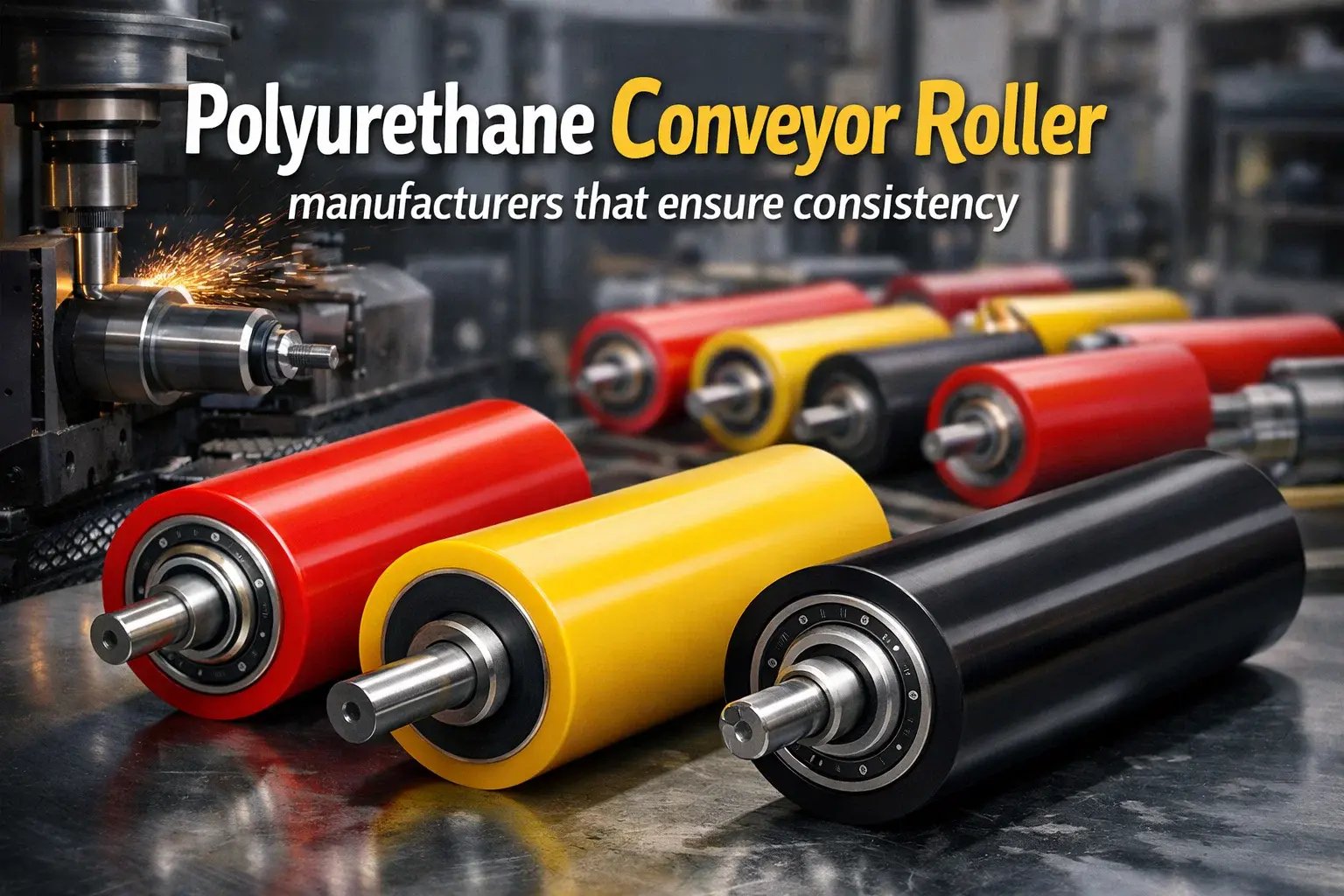
For industrial operations that depend on plastic conveyor components manufacturers and integrated conveyor component supply chains, understanding what consistency actually requires from a polyurethane roller manufacturer — and how to verify that a supplier is genuinely delivering it — is procurement intelligence that pays operational dividends over the life of every conveyor system it informs.
Consistency Starts With Controlled Raw Material Sourcing
Every polyurethane conveyor roller begins as a chemical formulation. The polyurethane compound — its hardness, resilience, tear resistance, and chemical resistance properties — is determined by the specific combination of polyol, isocyanate, and additive components used in its production. Variation in any of these inputs produces variation in the output, regardless of how well the manufacturing process is controlled downstream.
Manufacturers who ensure consistency at the raw material level maintain approved supplier lists for their chemical inputs, require material certificates with each delivery, and conduct incoming quality checks that verify the properties of each batch before it enters production. They do not source from the spot market when preferred suppliers are unavailable. They maintain buffer stock sufficient to sustain production from qualified material even when supply lead times extend.
This raw material discipline is invisible to buyers at the quotation stage. It does not appear on product data sheets. It is only revealed through the right questions — about approved supplier lists, incoming inspection protocols, and buffer stock management — or through the batch-to-batch consistency that becomes observable over multiple supply cycles.
Buyers who do not ask these questions are accepting raw material variability risk without knowing it. Those who do ask are identifying whether the consistency they need is structurally supported by the manufacturer's sourcing practices.
Formulation Control Determines Performance Repeatability
Beyond raw material quality, the precision with which a polyurethane formulation is mixed and applied determines whether the cured compound delivers its intended properties consistently. Polyurethane chemistry involves exothermic reactions whose progress is sensitive to mixing ratios, component temperatures, ambient humidity, and pour rates. Variation in any of these parameters affects the cross-link density of the cured compound — which in turn affects hardness, resilience, and wear resistance.
Manufacturers who ensure formulation consistency operate with precisely calibrated dispensing equipment, temperature-controlled component storage, documented mixing protocols, and environmental monitoring in production areas where humidity can affect reaction progress.
They also conduct cure property testing on production batches — hardness measurements, tensile testing, or abrasion resistance checks — that verify the cured compound has achieved its intended specification before components are released for finishing and dispatch.
This level of process discipline is not universal in polyurethane roller manufacturing. It is characteristic of manufacturers who have invested in understanding their process at a chemical engineering level, rather than treating polyurethane processing as a craft operation where experience substitutes for documented control.
For buyers sourcing Polyurethane Conveyor Roller manufacturers for high-throughput or high-criticality applications, formulation control capability is a meaningful qualification criterion that separates manufacturers who can guarantee consistency from those who can only aspire to it.
Core Preparation Quality Affects Long-Term Bond Integrity
A polyurethane conveyor roller is a composite component — a metal or polymer core with a polyurethane covering bonded to it. The long-term integrity of this bond is as important to roller consistency as the properties of the polyurethane compound itself. A roller whose covering delaminates from its core mid-service creates immediate system disruption and represents a complete failure of the component's intended function.
Bond integrity depends critically on core preparation. Metal cores must be cleaned, abraded, and primed with adhesive systems appropriate to the specific polyurethane formulation being applied. The preparation process must be completed within defined time windows — surface oxidation begins immediately after abrasion, and primers have limited open times within which bond strength develops fully.
Manufacturers who ensure consistent bond integrity have documented core preparation procedures with defined process windows, adhesive system qualification records, and bond strength testing protocols that verify adhesion quality on production batches.
Those who treat core preparation as a routine production step without documented controls introduce bond variability that manifests as delamination in service — often at elevated temperatures, under high loads, or in the presence of cleaning agents that stress the adhesive interface.
Dimensional Accuracy Requires Calibrated Finishing Operations
After curing and demoulding, polyurethane conveyor rollers typically undergo finishing operations — grinding, turning, or profiling — that establish the final dimensional specifications of the component. The accuracy of these operations determines whether the roller meets its specified diameter, face width, and profile geometry consistently across a production batch.
Finishing accuracy depends on calibrated machine tools with documented maintenance schedules, dimensional inspection at defined intervals during production runs, and final inspection protocols that verify critical dimensions before release.
Manufacturers who invest in this finishing discipline produce rollers whose dimensional consistency allows them to be installed interchangeably — without the sorting and selection that variable components require. Those who do not introduce dimensional variation that affects conveyor tracking, load distribution across roller sets, and the wear patterns that develop on belt or chain surfaces in contact with the rollers.
For buyers working with plastic conveyor wear strips manufacturer networks and managing conveyor systems where multiple roller positions must perform equivalently, dimensional consistency across production batches is not a quality preference. It is an operational requirement that the manufacturer's finishing process must reliably meet.
Hardness Verification Confirms Compound Performance Delivery
Polyurethane hardness — typically measured on the Shore A or Shore D scale depending on the compound — is one of the most operationally significant properties of a conveyor roller covering. It determines the contact area under load, the traction characteristics between roller and belt or chain, the roller's ability to absorb impact without permanent deformation, and its resistance to surface wear under abrasive contact.
Hardness variation between production batches — even within the nominal specification range — affects these operational characteristics in ways that can be significant in sensitive applications. A roller covering that is at the upper end of a hardness specification behaves differently under load than one at the lower end, even if both are technically within tolerance.
Manufacturers who take hardness consistency seriously conduct hardness measurements on every production batch using calibrated instruments, record results against the specification, and investigate any deviation from the target value before releasing the batch for dispatch. They can provide hardness certificates with delivery documentation on request.
Those who conduct only occasional hardness checks, or who rely on process consistency as a proxy for property consistency without direct measurement, introduce hardness variability that buyers absorb without visibility.
Surface Finish Consistency Affects System-Level Performance
The surface finish of a polyurethane conveyor roller affects its interaction with every surface it contacts — the belt or chain running over it, the products it supports or transports, and in some configurations the wear strips and guides it runs adjacent to.
A surface that is too smooth in a traction application allows belt slip under load. One that is too rough in a product contact application marks or damages the conveyed items. Inconsistency in surface finish across a roller set creates uneven traction distribution that affects belt tracking and load distribution.
Manufacturers who control surface finish as a specified parameter — rather than as an aesthetic characteristic — define their target finish, verify it through appropriate measurement, and maintain the process conditions that produce it consistently. This includes mould or mandrel surface condition management, release agent application consistency, and finishing process parameter control.
For buyers in food processing, pharmaceutical packaging, or product handling applications where surface finish has both functional and hygiene significance, surface finish consistency is a specification item that should appear explicitly in procurement documentation — not as an assumed characteristic.
Quality Documentation Enables Performance Traceability
Consistency over time requires not just consistent production practices but consistent documentation practices. When a performance question arises — a batch of rollers wearing faster than expected, a surface degradation pattern that does not match prior experience — the ability to trace specific units back to their production batch, raw material inputs, and process parameters is the foundation of effective root cause analysis.
Manufacturers with robust quality documentation maintain batch records that link finished components to their material certificates, process parameters, and inspection results. They can retrieve this information efficiently when a field performance question requires it. They treat documentation as an operational asset rather than a compliance burden.
This traceability capability is particularly valuable in long-term supply relationships where performance benchmarks are established over multiple supply cycles and any deviation from those benchmarks warrants investigation. Without batch traceability, performance investigations become subjective — a circumstance that serves neither the buyer nor the manufacturer well.
Conclusion
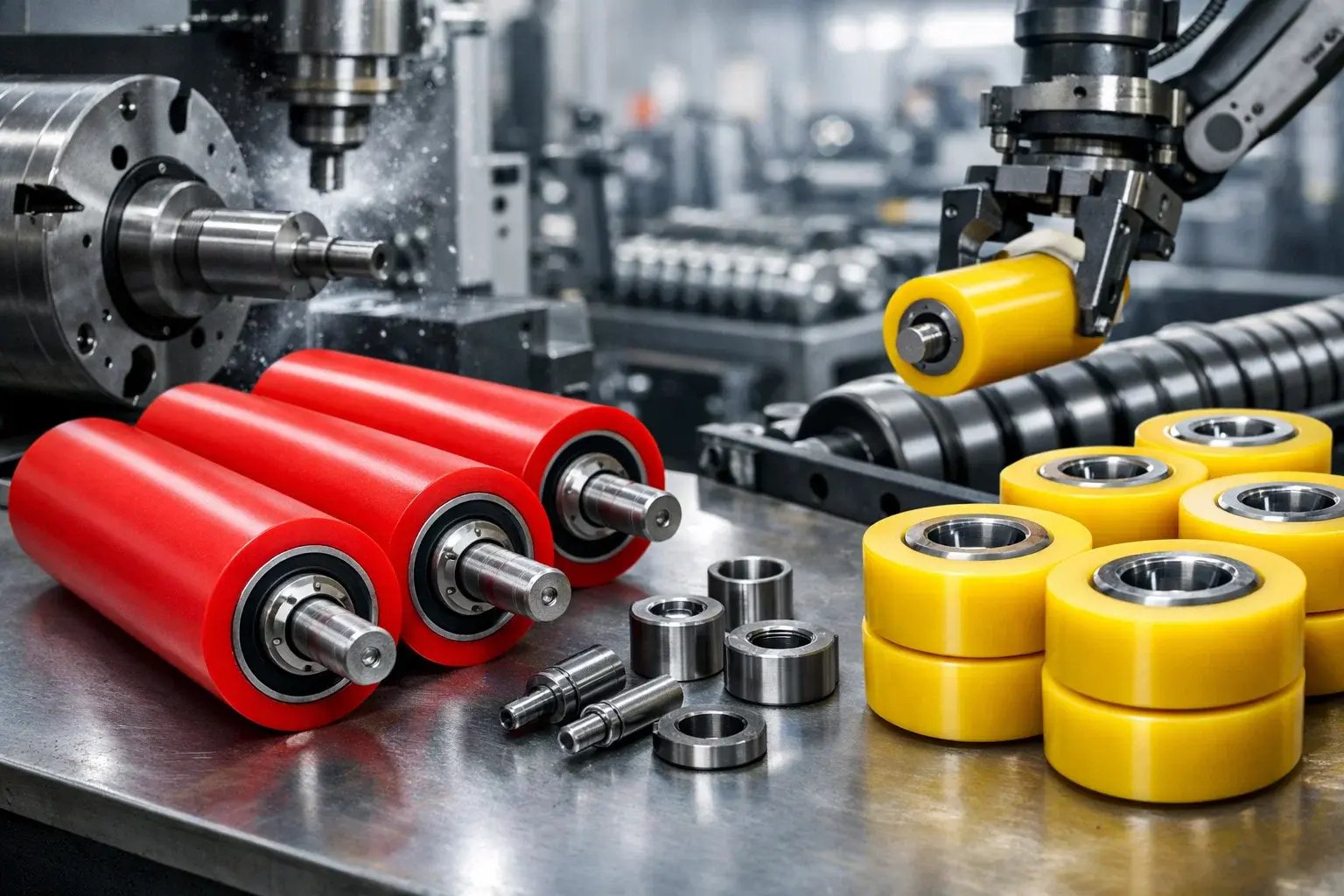
Consistency in polyurethane conveyor roller manufacturing is not a quality statement. It is an operational output produced by a specific combination of raw material discipline, formulation control, core preparation quality, finishing accuracy, property verification, and documentation rigour. Manufacturers who deliver it have built systems that make consistency structural. Those who claim it without these systems are relying on luck and stable conditions — neither of which is a reliable operational foundation.
For industrial buyers, procurement professionals, and SMEs who depend on conveyor system reliability, verifying consistency capability before committing to a supply relationship is the procurement practice that most directly reduces long-term operational risk. The qualification questions outlined in this article are not bureaucratic hurdles. They are the practical tools that separate manufacturers who can genuinely support your operations from those who can only supply components when conditions cooperate.
Building long-term supply relationships with Uhmwpe Chain Guide wholesalers and polyurethane conveyor roller manufacturers who demonstrate genuine consistency capability is how industrial operations achieve the conveyor system reliability that production planning depends on — not as an occasional outcome, but as a structural expectation.
FAQs
Why does raw material sourcing discipline matter for polyurethane roller consistency? Polyurethane compound properties are determined by the chemical inputs used in their production. Variation in those inputs — from spot market sourcing or inadequate incoming inspection — produces variation in cured compound properties that affects hardness, wear resistance, and bond integrity regardless of how well the downstream manufacturing process is controlled.
How can buyers verify that a manufacturer's formulation control is adequate? Ask about dispensing equipment calibration schedules, component temperature control practices, ambient environment monitoring in production areas, and cure property testing protocols for production batches. Manufacturers with genuine formulation control have documented answers to all of these questions.
What causes polyurethane roller covering delamination in service? Delamination typically originates in inadequate core preparation — insufficient abrasion, surface oxidation before primer application, adhesive system mismatched to the polyurethane formulation, or violation of primer open time windows. It manifests under conditions that stress the adhesive interface — elevated temperature, high load, or chemical exposure from cleaning agents.
How should hardness specification and verification be addressed in procurement documentation? Specify target hardness as a point value or narrow range rather than a broad tolerance band. Require hardness certificates with delivery documentation. Ask the manufacturer about their measurement frequency and instrument calibration practices. Hardness consistency within a narrow range is achievable by manufacturers with formulation control discipline.
What documentation should buyers request to support performance traceability in long-term supply relationships? Batch records linking finished components to material certificates, process parameters, and inspection results. Hardness certificates for each production batch. Dimensional inspection records covering critical measurements. These documents should be available as standard transaction accompaniments, not as special requests that require additional lead time.