
Storage capacity does not run out gradually and politely. It runs out at the worst possible moment — when an export order arrives larger than anticipated, when a supplier delivers ahead of schedule, when seasonal demand spikes faster than the forecast suggested, or when a third-party logistics arrangement collapses without warning.
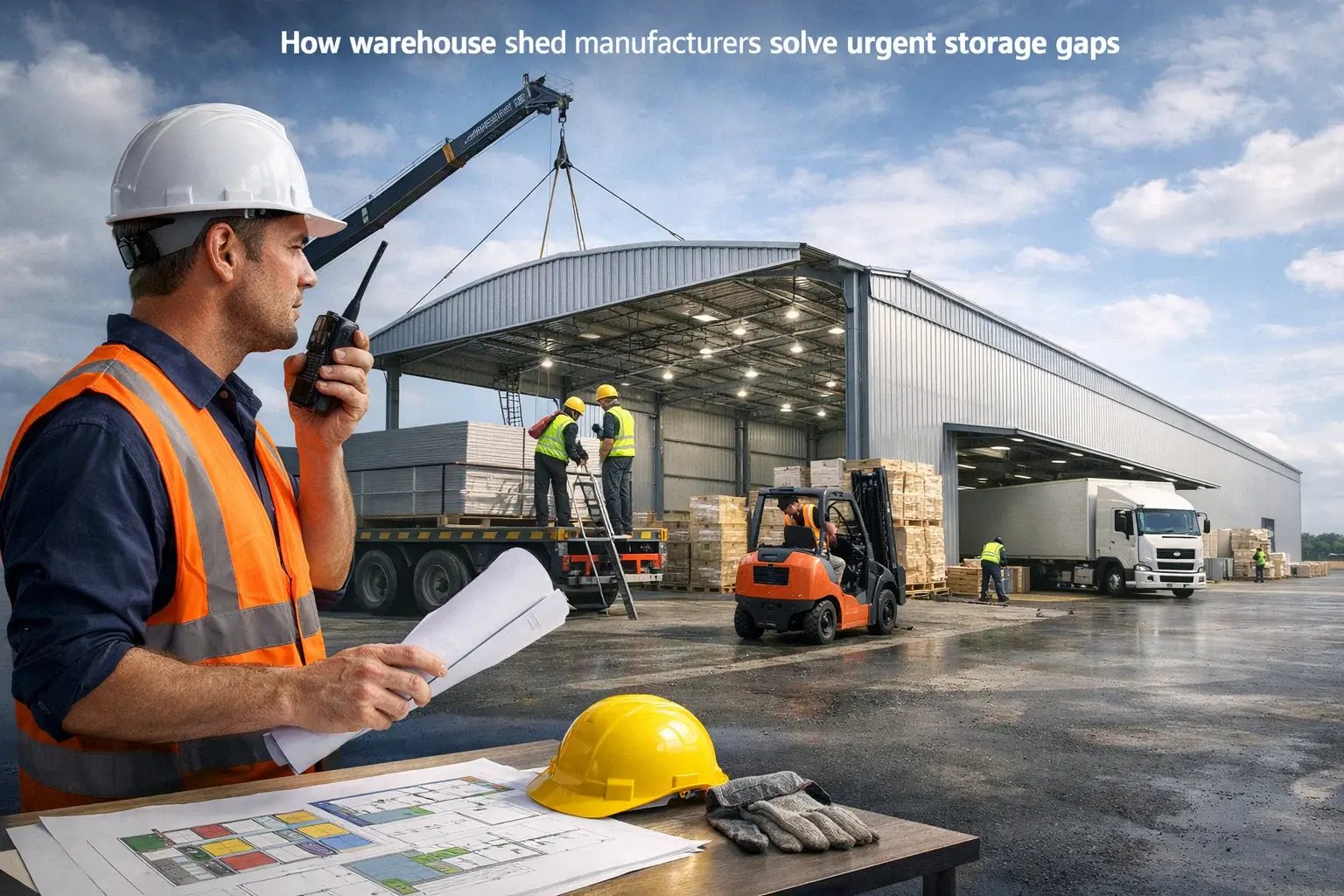
This is the operational context in which warehouse shed manufacturers have developed specific capabilities — engineering approaches, production systems, and project delivery models — that allow industrial storage structures to be designed, fabricated, and erected significantly faster than conventional construction methods while maintaining the structural integrity and operational functionality that a permanent facility requires.
This article is for business owners, operations managers, and procurement leads who are dealing with a storage gap now or anticipating one and want to understand what a structured, fast-track steel warehouse solution actually involves.
Why Storage Gaps Are More Expensive Than They Appear
The visible cost of a storage gap is the one that shows up immediately — the rental rate on temporary space, the cost of external logistics to manage overflow inventory, or the expedited freight required to move product faster than the normal cycle allows.
The less visible costs are frequently larger. Product stored in suboptimal conditions — outdoor staging, inadequately covered temporary structures, or third-party facilities with inconsistent handling standards — is exposed to damage, shrinkage, and quality deterioration that reduces its value or makes it unusable. For exporters and manufacturers supplying quality-conscious B2B buyers, damaged or degraded inventory is not just a financial loss — it is a relationship risk with customers whose confidence is difficult to rebuild once compromised.
Production constraint is another invisible cost. When finished goods have nowhere to go, production lines slow or stop. The cost of idle manufacturing capacity — fixed overhead, labour, equipment depreciation — continues accumulating while output halts. The revenue impact of constrained production compounds across every week the storage problem persists.
Operational inefficiency scales with the workaround. Managing inventory across multiple dispersed locations — main facility, overflow rental space, third-party warehouse — adds coordination complexity, increases handling touchpoints, and reduces the visibility and control that effective inventory management requires. The administrative and operational cost of this complexity is real and ongoing.
When these costs are totalled and compared against the cost of a purpose-built storage structure, the financial case for permanent infrastructure becomes considerably clearer — particularly when a fast-track delivery model reduces the time between decision and occupancy to a fraction of conventional construction timelines.
What Makes Steel Warehouse Sheds the Default Solution for Urgent Storage
Steel warehouse shed construction has become the default solution for urgent industrial storage requirements not because it is the only option but because it consistently outperforms alternatives across the dimensions that matter most when speed, cost, and operational functionality are all under pressure simultaneously.
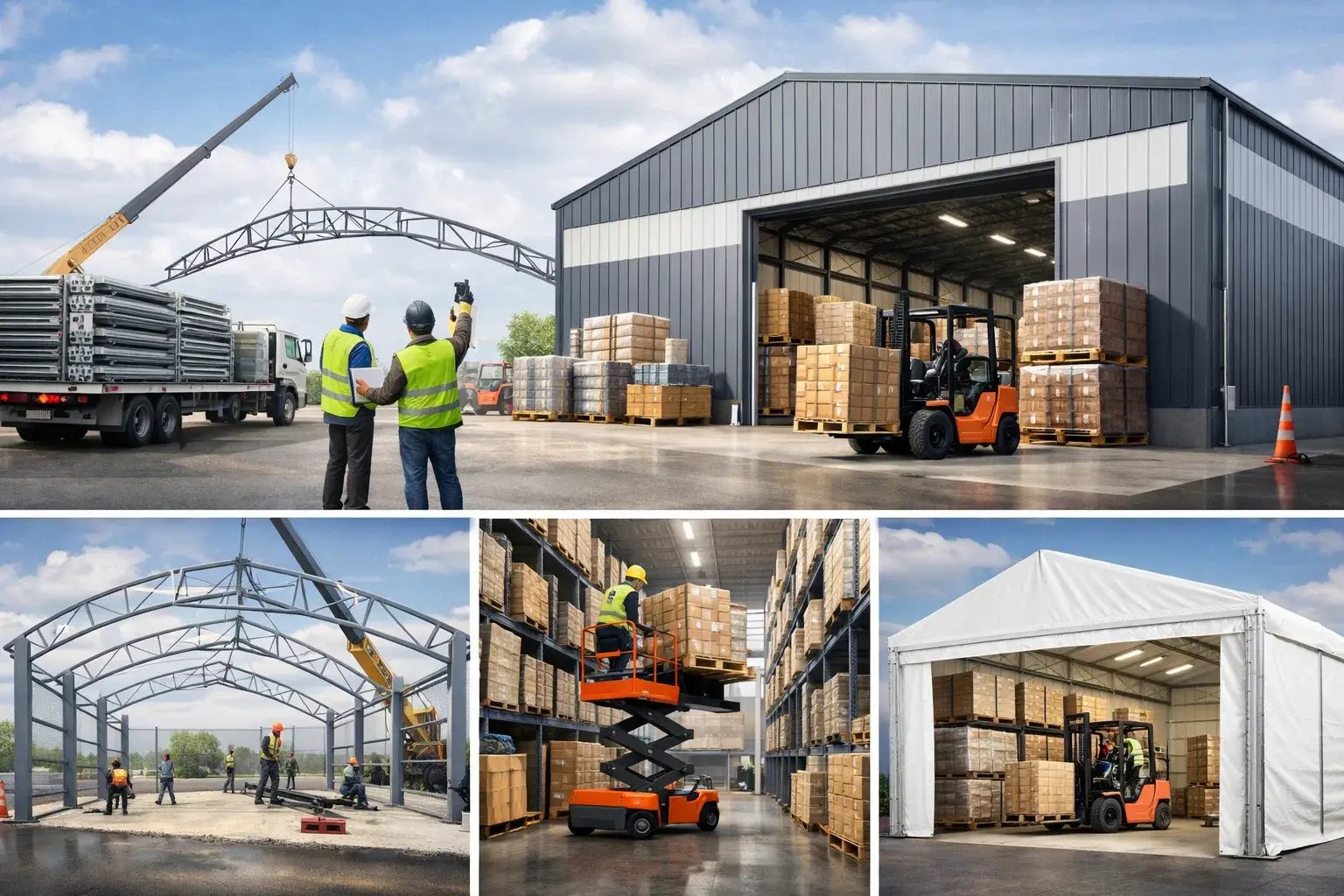
Speed of delivery is the primary advantage. A steel warehouse shed can move from design to operational occupancy in a timeline that conventional masonry or concrete construction cannot match. Factory prefabrication of structural components means that the majority of construction activity happens in parallel with site preparation and foundation work, rather than sequentially after it. When components arrive on site, erection proceeds rapidly because the building is being assembled from precision-manufactured elements rather than constructed from raw materials.
Structural flexibility allows steel warehouse sheds to be configured for a wide range of storage requirements without significant cost premium. Clear span configurations — where the internal space is column-free across the full width of the building — are straightforward in steel construction and provide the operational flexibility that forklift access, racking installation, and changing inventory configurations require. Column-free spans of twenty metres, thirty metres, or more are achieved routinely in steel shed construction. Equivalent spans in conventional construction are expensive, structurally complex, and slow to build.
Scalability is an advantage that becomes relevant as the business grows beyond the initial storage requirement. A steel warehouse shed can be extended longitudinally — by adding additional bays to the end of the existing structure — with relatively modest structural and programme implications. The original structure is designed with this extension capability in mind, making future expansion a planned investment rather than a major construction project. Conventional construction offers much more limited and expensive extension options.
Cost predictability reflects the manufacturing discipline of the prefabricated steel construction process. A well-specified steel warehouse shed from a reputable manufacturer can be priced accurately at the design stage, with a fixed contract price that reflects real production costs rather than estimates subject to site-condition variations. This cost predictability matters significantly for businesses managing storage investments against tight operational budgets.
How Warehouse Shed Manufacturers Approach Fast-Track Projects
Fast-track project delivery is not simply a matter of working harder or faster. It requires a specific set of engineering, production, and project management capabilities that not all warehouse shed manufacturers possess. Understanding what these capabilities involve helps buyers identify suppliers who can genuinely deliver a compressed timeline rather than simply commit to one.
Concurrent engineering and production planning is the foundation of fast-track delivery. In a standard project sequence, structural design is completed before fabrication drawings are prepared, which are completed before production begins. In a fast-track model, these stages overlap — production planning begins before design is finalised, material procurement is initiated before fabrication drawings are complete, and site preparation begins before fabrication is underway. This concurrency requires tight coordination between the engineering team, the production planning team, and the project management function — and it requires a supplier whose organisational structure supports this coordination rather than working in sequential departmental handoffs.
Prioritised production scheduling means that a fast-track order enters the production queue with defined priority status rather than being inserted into the standard order sequence. This requires a supplier with genuine production planning visibility — who knows their current order book position and can honestly advise on the earliest available production slot. A supplier who agrees to a compressed timeline without this visibility is making a commercial commitment that their production reality may not support.
Experienced erection teams with the specific skills and equipment required for fast-track steel warehouse erection are not universally available. Erection productivity on site is determined by the erection supervisor's experience with the specific building configuration, the crew's familiarity with the erection sequence, and the availability of appropriate lifting equipment sized correctly for the building geometry. A manufacturer who maintains trained erection teams as a permanent resource — rather than subcontracting erection to the lowest available labour hire — delivers more predictable erection productivity and better programme adherence.
Foundation coordination is the site-side activity that most commonly constrains fast-track programmes. Steel warehouse erection cannot begin until foundations are complete and anchor bolts are set to the positional tolerances required by the structural design. A manufacturer with fast-track capability provides foundation design information — anchor bolt layout, loading data, and positional tolerance requirements — to the civil contractor at the earliest possible stage, allowing foundation work to begin and complete before fabricated components arrive on site.
Specification Decisions That Affect Storage Functionality
Speed of delivery is the primary driver in urgent storage situations, but the specification decisions made during the fast-track design process have long-term consequences for operational functionality that deserve careful attention even under time pressure.
Clear height determines what racking configuration is possible within the building and, therefore, how efficiently the available floor area can be utilised for storage. A building designed with insufficient eave height for the racking system the business intends to install is a permanent functional limitation that cannot be economically remediated after construction. Confirming the racking height requirement — including the clearance required above the highest storage level for forklift operation and sprinkler systems where applicable — before finalising the structural design is essential.
Floor loading specification determines what the concrete floor slab can support — both in terms of uniformly distributed loads from racking systems and point loads from forklift and reach truck wheels. A floor slab that is underspecified for the intended racking and materials handling equipment is a safety risk and a practical limitation on storage density. The floor slab specification should reflect the actual operational loading, not a generic industrial standard that may or may not be appropriate for the specific application.
Ventilation and lighting design affects the working conditions within the warehouse and, for some product categories, the suitability of the environment for storage. Temperature-sensitive products, humidity-sensitive materials, and goods requiring specific light conditions all place specific requirements on the building envelope and services design that need to be addressed in the original specification rather than retrofitted after occupancy.
Access configuration — the number, size, and location of roller shutter doors, personnel doors, and vehicle access points — determines how efficiently goods can move in and out of the facility. For operations with high throughput, multiple large-format roller shutter doors aligned with the internal traffic flow pattern are a productivity investment, not simply a convenience. Getting the access configuration right at the design stage costs nothing additional. Modifying it after construction is disproportionately expensive.
Managing the Procurement Process Under Time Pressure
Urgency in procurement is the condition that most consistently produces poor outcomes. When the pressure is immediate, the temptation is to compress the supplier evaluation process, accept the first credible quotation, and move forward before the comparative assessment that good procurement requires.
The consequences of this compression in warehouse shed procurement are predictable. Scope ambiguity produces variations that inflate the contract price. Supplier capability gaps produce programme delays that extend the very timeline the buyer was trying to compress. Quality shortfalls produce a building that does not perform as intended for the operational life it was meant to serve.
The solution is not to slow down the procurement process but to make it more efficient. A structured RFQ that defines the scope clearly — floor area, clear height, floor loading, access configuration, site conditions, and required occupancy date — allows multiple suppliers to quote against the same basis simultaneously rather than sequentially. The time invested in scope definition at the beginning of the procurement process saves multiple times that investment in clarification, revision, and variation management throughout the project.
Reference checking can be conducted in parallel with quotation evaluation rather than sequentially after a preferred supplier is selected. Speaking with two or three project owners who have completed comparable projects with the shortlisted suppliers takes a few hours and provides more reliable capability evidence than any amount of supplier-provided documentation.
Understanding how pre engineered building manufacturers structure their project delivery process — the sequence from design confirmation through production to site completion — gives you a framework for evaluating whether a supplier's proposed timeline is realistic or optimistic. A supplier who can explain their production process, identify the critical path activities, and demonstrate how their proposed timeline accounts for each of them is demonstrating a level of planning discipline that supports confidence in their delivery commitment.
The Operational Transition: From Construction to Storage
The period between structural completion and operational storage occupancy is frequently underplanned and occasionally chaotic. The building is handed over. The floor slab is complete. And then the business discovers that the racking installation lead time is six weeks, the electrical contractor cannot connect power for three weeks, and the goods that were staged in temporary overflow space cannot actually move in until both are complete.
Planning the operational transition before construction begins — identifying every activity required between structural handover and first goods-in, establishing the lead times and sequencing for each, and integrating them into the project programme — is straightforward in principle and frequently neglected in practice.
The warehouse shed manufacturer's role formally ends at structural handover. But a manufacturer with genuine project partnership capability will flag transition planning gaps during the design phase, advise on sequencing considerations that affect the erection programme, and provide handover documentation — structural drawings, material certificates, maintenance guidance — in a form that the building owner can use operationally from the first day of occupancy.
Conclusion: Permanent Infrastructure, Not Just a Quick Fix
These capabilities exist in the market. Finding suppliers who possess them — and verifying that possession through evidence rather than assurance — is the procurement task that matters most when storage capacity runs out and the pressure to act is immediate.
For industrial facilities that are also planning energy infrastructure, the storage solution and the energy solution are more connected than they might initially appear. The roof of a well-built warehouse shed is a productive asset as well as a structural one. Working with experienced switchgear panel manufacturers who understand how electrical infrastructure integrates with warehouse operations and rooftop energy systems ensures that the building you construct today supports the operational and energy capability you will need tomorrow.
A warehouse shed built under time pressure does not have to be a compromise. With the right supplier, selected through a rigorous enough process, it can be exactly what the business needs — delivered in the timeline the business requires.
FAQs
What is the fastest realistic timeline for a warehouse shed from design to occupancy for an urgent storage requirement? For a straightforward single-span warehouse shed in the range of 500 to 1,500 square metres on a prepared site with no significant permit delays, a realistic fast-track timeline from design confirmation to structural completion is eight to fourteen weeks. Adding the time required for foundation construction, floor slab curing, and services installation typically brings the total design-to-occupancy timeline to twelve to eighteen weeks. Smaller structures with simpler configurations and readily available production slots at the manufacturer's facility can achieve the lower end of this range. Larger or more complex structures, sites with difficult ground conditions, or jurisdictions with slow permit approval processes should plan for timelines at the upper end or beyond.
Can a warehouse shed be designed now and extended later without structural compromise? Yes, provided the original structure is designed with extension in mind. This means specifying end frames that are structurally compatible with future bay additions, sizing the foundation at the extension end to support future loading, and ensuring that the roof drainage system can be adapted when the building length increases. A manufacturer who designs with extension capability from the outset makes future expansion a straightforward incremental construction project rather than a structurally complex modification.
What floor loading specification is appropriate for a general-purpose industrial warehouse shed? A general-purpose industrial warehouse floor slab is typically designed for uniformly distributed loads in the range of 50 to 80 kilonewtons per square metre, with point load capacity reflecting the wheel loads of the materials handling equipment to be used. For operations involving heavy racking systems, narrow aisle forklifts, or reach trucks with high axle loads, the specification should be confirmed against the actual equipment data rather than assumed from generic industrial benchmarks. An underspecified floor slab is a safety risk and a practical constraint on storage density that is expensive to remedy after construction.
How do I protect against quality shortcuts when a warehouse shed is procured under time pressure? The most effective protection is contractual — a technical specification that defines material grades, fabrication tolerances, surface treatment standards, and inspection requirements precisely enough that there is no ambiguity about what compliant delivery looks like. Supplementing this with an independent third-party inspection at the fabrication stage — before components are dispatched — catches quality shortfalls while remediation is still straightforward and inexpensive. Do not rely on supplier assurance or post-erection inspection alone when time pressure is high, as both increase the risk of quality compromises being discovered after the point at which they can be economically remediated.
What site preparation is required before a warehouse shed erection crew can mobilise? The minimum site preparation requirements for steel warehouse shed erection are: completed and inspected foundations with anchor bolts set within the positional tolerances specified by the structural engineer, a cleared and levelled working area around the building footprint adequate for crane operation and component staging, defined and accessible site access for heavy vehicle delivery of fabricated components, and a confirmed power supply for erection tools and lighting. Sites that do not meet these conditions when the erection crew mobilises incur standing time costs and programme delays that are avoidable with proper pre-mobilisation site preparation planning.