
For factory owners, warehouse developers, logistics operators, and industrial investors who are evaluating steel shed construction, durability is the quality dimension that carries the highest long-term financial consequence and receives the least attention during procurement. Cost and programme are immediate and quantifiable. Durability is deferred and difficult to assess from a quotation document. This asymmetry consistently produces procurement decisions that optimise for visible cost at the expense of long-term structural performance — and that deliver the financial consequences of that optimisation across decades of ownership.
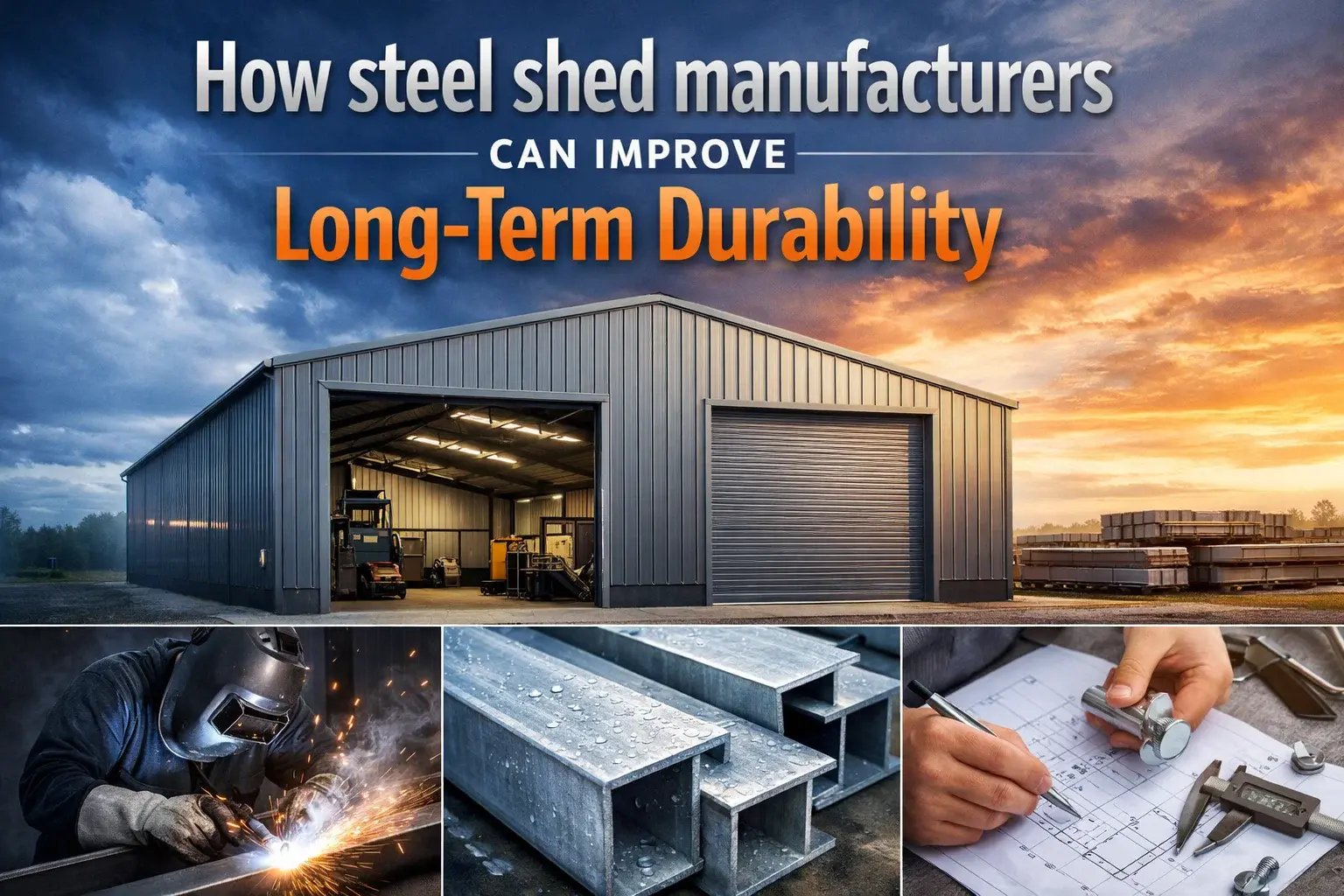
This article is written to correct that asymmetry. It examines what steel shed manufacturers who deliver genuinely durable structures do differently from those who do not — at the design stage, during fabrication, during erection, and in the documentation they provide at handover. Understanding these differences gives buyers the framework to evaluate durability as a procurement criterion with the same rigour they apply to cost and programme.
What Long-Term Durability Requires: The Three Structural Dimensions
Durability in a steel shed structure is not a single characteristic. It is the aggregate of performance across three distinct structural dimensions, each of which is affected by different decisions during the design and fabrication process.
Structural integrity across the design life is the ability of the building to carry its design loads — dead loads, live loads, wind loads, and any equipment or dynamic loads specific to the intended use — consistently across the full design life of the structure without degradation of load-carrying capacity. Structural integrity is primarily determined by material quality, structural design adequacy, fabrication accuracy, and connection performance.
Corrosion resistance across the operational environment is the ability of the structural members and connections to resist the electrochemical degradation that occurs when steel is exposed to moisture, oxygen, and environmental contaminants specific to the site — industrial pollutants, coastal chlorides, agricultural chemicals, or general atmospheric conditions. Corrosion resistance is primarily determined by the surface treatment system applied during fabrication and the drainage design of the building envelope.
Envelope performance across weather exposure is the ability of the roofing and cladding system to maintain its weathertightness, thermal performance, and aesthetic condition across the operational life of the building. Envelope performance is determined by material specification, installation quality, and the design of joints, penetrations, and interfaces between different envelope components.
A manufacturer who excels across all three dimensions produces a structure that performs as designed for its full intended life with predictable and manageable maintenance requirements. A manufacturer who is strong in one dimension but weak in another produces a structure whose durability is limited by the weakest dimension — which may not be apparent until the deficiency manifests as a structural, corrosion, or weathertightness problem that is expensive to address after the fact.
Material Selection and Specification: The Foundation of Structural Durability
The durability of a steel shed structure begins with the material from which it is made. Every subsequent operation — welding, coating, erection — is applied to that material. If the material properties are inadequate for the design loads, or if the material grade does not match what the structural engineer specified, no amount of quality in subsequent operations can compensate.
Steel grade specification and verification is the first material durability discipline. The structural engineer specifies steel grades — IS 2062, ASTM A36, EN S275, or equivalent depending on the applicable standard — based on the yield strength, ductility, and weldability requirements of the structural design. The specification is only as valuable as the verification that the material actually used matches it.
Verification requires mill certificates that document the chemical composition and mechanical properties of each material heat, indexed to the specific sections used in fabricated components. A manufacturer who maintains documented material traceability — from mill certificate through to fabricated component — provides verifiable evidence that specified grades were used. One who procures material without mill certificates or without maintaining traceability between certificates and components is relying on assumed compliance rather than verified compliance.
For buyers who accept general quality assurances without requesting specific material traceability documentation, the risk of material substitution — intentional or through inadequate incoming quality control — is a real and unmanaged exposure that affects structural performance across the building's operational life.
Cladding material specification for roofing and wall panels determines envelope durability with the same directness that steel grade determines structural durability. The base metal thickness, the zinc or aluminium-zinc coating weight, and the paint system specification of profiled steel sheeting all affect how long the cladding maintains its corrosion resistance in the specific environmental conditions of the site.
In coastal environments, industrial atmospheres, or high-humidity locations, standard cladding specifications adequate for benign inland environments may be insufficient. A manufacturer who specifies cladding based on cost rather than environmental corrosivity — without assessing the specific conditions of the site — delivers a building whose envelope durability is compromised from the outset.
Understanding the environmental corrosivity category of the site — assessed against the ISO 9223 or equivalent standard — and specifying cladding materials appropriate to that category is a durability discipline that quality manufacturers apply as standard practice and that buyers should require as a minimum procurement condition.
Structural Design Decisions That Affect Decades of Performance
Beyond material selection, structural design decisions made during the engineering phase have long-term durability implications that are not apparent in the initial appearance of the structure.
Drainage design is the structural design decision with the most direct and most underappreciated impact on long-term durability. Water that drains cleanly and completely from all surfaces of the structure — roof, gutters, wall base, and connections — does not create the sustained moisture exposure that drives corrosion. Water that pools at structural interfaces, collects in horizontal members, or infiltrates through inadequately detailed penetrations creates persistent moisture exposure that accelerates corrosion at exactly the locations where corrosion has the most consequence — connections, base plates, and primary structural members.
Quality manufacturers design drainage as a structural system — ensuring that roof pitches are adequate for the cladding profile, that gutters are sized for the catchment area and local rainfall intensity, that downpipes are positioned to manage roof drainage without overloading individual outlets, and that base conditions prevent water ponding against column base plates. Manufacturers who treat drainage as an afterthought to structural design produce buildings where drainage deficiencies are discovered after erection, when remediation is expensive and disruptive.
Connection detailing for long-term durability addresses the specific conditions at structural connections that make them more vulnerable to corrosion than open structural members. Connections create crevices where moisture is trapped, dissimilar metal interfaces where galvanic corrosion can occur, and surface treatment discontinuities where coating coverage is more difficult to achieve and inspect.
Quality manufacturers detail connections to minimise crevice formation — using closed sections where open sections would create moisture traps, specifying appropriate sealants at bolted interfaces in exposed locations, and designing connection geometry to facilitate coating application and inspection. These details add modest complexity to connection design and fabrication but have a significant impact on the corrosion performance of connections across the building's operational life.
Roof penetration detailing addresses the weathertightness of all openings through the roof envelope — for services, ventilation, structural supports, and any future provisions. Penetrations that are not correctly detailed and installed are the most common source of weathertightness failures in steel shed buildings. Quality manufacturers develop standard penetration details that have been refined through operational experience and that are applied consistently across all penetrations in the building.
Surface Treatment: The Durability Variable With the Highest Long-Term Financial Consequence
Surface treatment is the fabrication operation with the most direct and most quantifiable impact on long-term durability — and the one where quality variation between manufacturers is widest and least visible to buyers at the procurement stage.
The performance of a protective coating system on structural steel is determined overwhelmingly by the quality of surface preparation achieved before coating application. A coating system applied over inadequately prepared steel — whether the inadequacy is in cleanliness, surface profile, or the removal of mill scale, rust, and contaminants — will adhere poorly, blister prematurely, and allow corrosion to undercut from edges, welds, and imperfections. A coating system applied over properly prepared steel will perform as the coating manufacturer's technical data sheet predicts.
Surface cleanliness standard is defined by the ISO 8501-1 or equivalent standard. Sa 2.5 — near-white metal cleanliness — is the standard most commonly specified for structural steel in industrial environments, requiring removal of all visible mill scale, rust, and contaminants to a defined level of surface cleanliness assessed by comparison with photographic reference standards. Achieving Sa 2.5 consistently requires adequate blasting equipment, properly graded abrasive media, correct blasting technique, and quality inspection to verify the achieved standard before coating application begins.
Manufacturers who verify surface cleanliness through documented inspection — recording the achieved standard on defined surface areas before primer application — are managing this quality variable systematically. Those who apply coating without verification are relying on assumed compliance that may or may not reflect reality.
Surface profile — the roughness achieved by abrasive blasting — affects coating adhesion by providing the mechanical anchor profile that the coating film keys into. The specified surface profile for a coating system is defined in micrometres of Rz roughness and must be achieved within a defined range — too smooth provides insufficient mechanical key, too rough creates peak tips that are incompletely covered by the coating film and become early corrosion initiation points.
Dry film thickness verification after coating application confirms that the specified coating thickness has been achieved across all surfaces — including the edges, welds, and connection areas where coating coverage is most difficult to achieve and most critical for corrosion protection. Measurement with calibrated magnetic gauges at defined frequency, with results documented against the specified minimum, average, and maximum values, provides verifiable evidence of coating adequacy that visual inspection cannot provide.
For buyers who do not require surface treatment inspection documentation as a contractual deliverable, the quality of surface preparation and coating application is invisible at handover and becomes visible only when coating performance falls short of expectations in service — which by then is too late for any remedy other than premature recoating.
Fabrication Precision and Its Contribution to Long-Term Performance
Fabrication precision — the dimensional accuracy with which structural components are manufactured relative to the fabrication drawing — contributes to long-term durability through mechanisms that are less direct than material quality or surface treatment but equally consequential across the operational life of the structure.
Connection geometry accuracy determines how structural connections perform under load. Connections whose geometry deviates from the design assumption — because column base plates are not perpendicular to the column axis, because beam end plates are not parallel to the connection face, or because hole positions do not align with the mating component — must be accommodated during erection through shimming, re-drilling, or force-fitting. These accommodations introduce eccentricities and stress concentrations that were not present in the structural design and that affect connection fatigue life under cyclic loading.
Member straightness and camber affect both the visual appearance and the structural performance of the completed building. Members that are not straight within specified tolerances create connection geometry deviations at every end, compounding the connection accuracy issues described above. Members that do not achieve the specified camber — the pre-set upward deflection that compensates for dead load deflection — produce finished roof lines that slope incorrectly and drainage systems that do not perform as designed.
Hole position accuracy determines whether bolted connections can be assembled without modification. Hole positions outside tolerance require site remediation — reaming, re-drilling, or in some cases component replacement — that adds programme time, increases erection cost, and introduces structural modifications that were not part of the original design. The cumulative programme and cost impact of dimensional inaccuracies across a complete steel shed erection is significant.
Quality manufacturers manage fabrication precision through calibrated measurement equipment maintained on a defined calibration schedule, in-process dimensional inspection at defined production stages, and pre-dispatch verification of completed components against fabrication drawing dimensions. The inspection records produced by this process provide verifiable evidence of dimensional compliance that protects the buyer's interests — both at handover and in any future assessment of the structure's as-built condition.
Erection Quality and Post-Erection Protection
The durability disciplines that begin in the design office and fabrication facility must be carried through the erection process to be effective. Erection practices that compromise the surface treatment applied during fabrication, that create drainage problems through incorrect installation, or that introduce structural defects through poor erection technique undermine the durability investment made in design and fabrication.
Surface treatment protection during handling and erection requires that fabricated components be handled, transported, and erected in a way that minimises mechanical damage to the coating system. Components that are dragged across abrasive surfaces, impacted by lifting equipment, or stored in contact with other components without adequate dunnage protection arrive on site with coating damage that requires touch-up before erection proceeds — or, if not addressed, with exposed steel that becomes an early corrosion initiation point.
Quality erection teams use appropriate lifting attachments that do not damage coating, maintain adequate dunnage between stacked components, and conduct a systematic coating inspection and touch-up program before erection of each component. The touch-up paint used should match the specification of the original coating system — including primer type and colour — not be a generic rust-inhibiting paint that is incompatible with the finish coat applied over it.
Bolted connection installation requires that structural bolts be tightened to the specified torque using calibrated torque wrenches, that bolt torque be verified and documented for friction grip connections, and that exposed bolt heads and threads be protected against corrosion after erection by application of a compatible sealant or coating system. Bolts that are not tightened to the specified torque create connection slip that can affect structural performance under dynamic loading. Unprotected bolt threads in exposed or wet locations become corrosion initiation points that can compromise connection integrity over time.
Post-erection protection of structural interfaces addresses the corrosion risk at locations where the building structure meets the ground or civil works — specifically, column base plates and the transition between the steel structure and the concrete foundation. Base plates in contact with concrete or soil are exposed to persistent moisture and are among the most vulnerable locations for corrosion in a steel shed structure. Quality manufacturers specify and install appropriate sealant or isolation systems at these interfaces, and the design of the base plate and anchor bolt assembly incorporates features that facilitate inspection and maintenance of these critical locations across the building's operational life.
Documentation as a Durability Asset
The documentation produced during design, fabrication, and erection of a steel shed is not merely a contractual formality. It is a durability asset that supports effective maintenance, informed modification, and reliable compliance assessment across the operational life of the building.
Mill certificates, surface treatment inspection records, dimensional inspection reports, and as-built drawings collectively define the as-built condition of the structure in terms that allow future structural assessments, maintenance planning, and modification design to proceed from verified knowledge rather than assumption. The value of this documentation compounds over time — it is most consequential when the building is assessed for modification, when an insurance claim requires structural evidence, when a rooftop solar installation requires structural capacity verification, or when a regulatory inspection requires compliance documentation.
Manufacturers who treat documentation as a professional obligation produce complete, accurate, indexed records that are delivered at handover in a form the building owner can use. Those who treat documentation as a contractual minimum produce the minimum paperwork required to release final payment — which may or may not be adequate for the owner's long-term needs.
Specifying documentation deliverables as named contractual conditions of final payment — with defined content requirements and submission formats — is the procurement mechanism that ensures documentation completeness. Without this contractual structure, the documentation quality that results reflects the manufacturer's professional standards rather than the buyer's operational needs.
Conclusion
For industrial project owners who are building facilities that will serve their operations for decades — and that may also carry rooftop solar installations, overhead infrastructure, or other long-term investments — the durability of the structural investment is the foundation on which everything else depends.
Working with established rooftop solar for factories specialists who understand how structural quality, surface treatment durability, and building envelope performance interact with solar installation requirements gives the complete facility — structure and energy infrastructure together — a performance foundation that earns its cost across the full operational life of the investment.
Durability is designed in. The time to make the decisions that determine it is before the contract is signed — not after the problems appear.
FAQs
What environmental factors most significantly affect the required surface treatment specification for a steel shed in an industrial location?
The primary environmental factors are atmospheric corrosivity — determined by the concentration of sulphur dioxide, chloride, and other corrosive agents in the local atmosphere — humidity, and temperature cycling.
How long should a properly designed and constructed steel shed last before requiring major structural intervention?
A steel shed designed to the applicable structural standard, fabricated from verified material grades, treated with a coating system appropriate to the site environment, and maintained according to a documented maintenance programme should have a structural life of fifty years or more without major structural intervention.
What are the most common locations in a steel shed structure where corrosion originates and how can they be addressed during design?
The locations most consistently associated with early corrosion initiation are column base plates and their interfaces with concrete foundations, where moisture is persistent and drainage is limited; horizontal hollow sections and angles where water ingress leads to internal corrosion that is not visible externally until advanced.
How does the choice between hot-rolled and cold-formed secondary steel members affect long-term durability? Hot-rolled sections generally have greater surface treatment adhesion due to their surface texture and are more tolerant of minor coating damage during handling. Cold-formed sections have sharper edges that are more difficult to coat adequately — the coating tends to pull away from sharp edges during application, leaving thin coverage at exactly the locations most susceptible to corrosion initiation.
What maintenance programme should a steel shed owner implement from the first year of occupancy to protect long-term durability?
An effective maintenance programme for a steel shed structure should include annual visual inspection of the complete building envelope — roof, gutters, downpipes, wall cladding, and all penetrations — to identify and address minor weathertightness defects before they develop into significant water ingress problems.