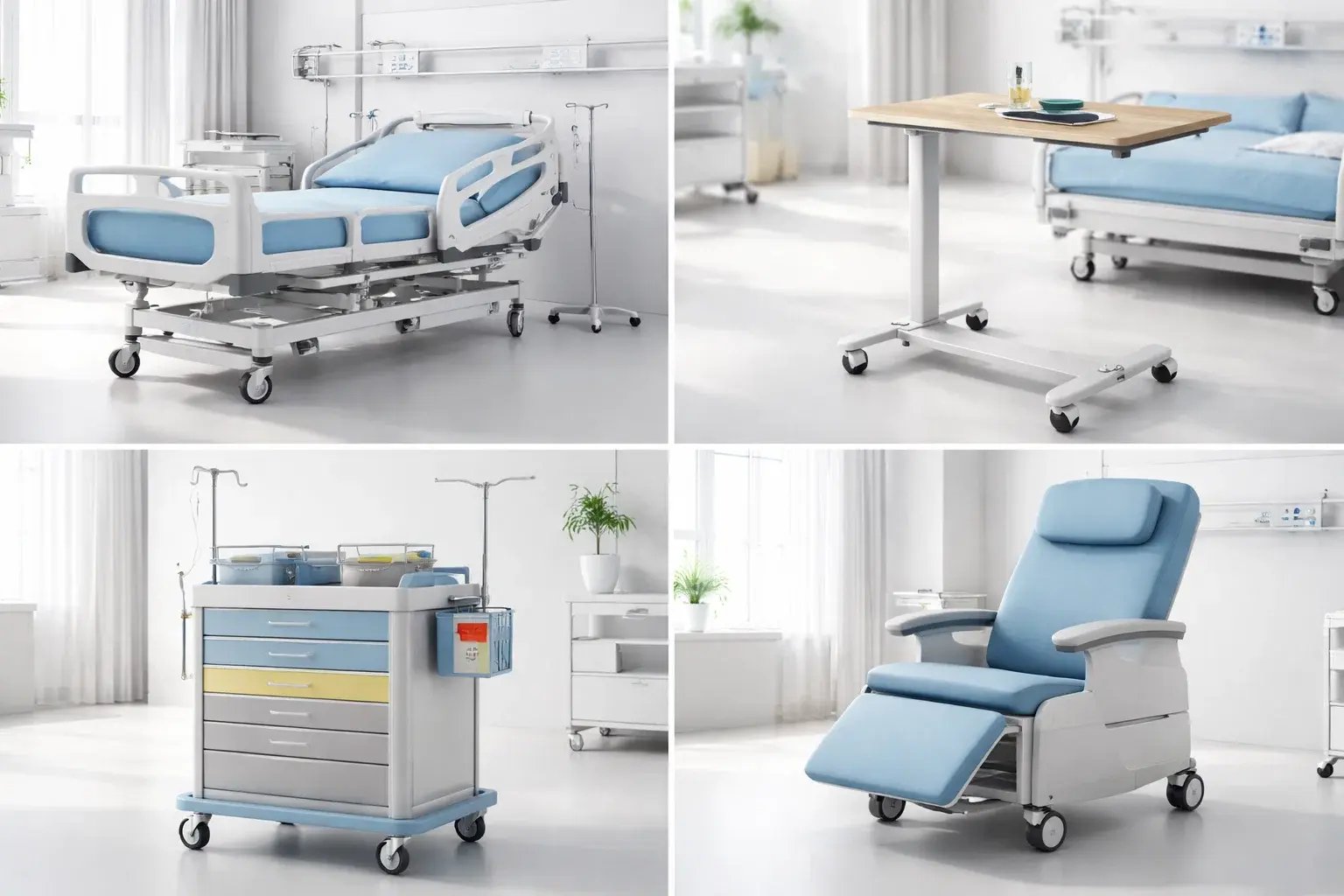


When supply gaps occur at the institutional level, the consequences extend beyond procurement inconvenience. Patient admissions are delayed. Clinical workflows are disrupted. Capital expenditure timelines slip. In publicly funded healthcare, political and regulatory accountability follows quickly.

For procurement teams beginning this process, working with verified Hospital Bed Manufacturers who have structured supply chain visibility and documented production capacity is the most reliable starting point for closing gaps before they become crises.
How Supply Gaps Form in the Hospital Furniture Segment
Supply gaps in hospital beds and related medical furniture do not typically appear without warning. They develop through a series of compounding factors that, individually, seem manageable — but together create serious procurement exposure.
Demand Surges That Outpace Production Planning
Healthcare infrastructure investment moves in cycles. When a region or country accelerates hospital construction — driven by government policy, private investment, or population growth — the downstream demand for equipment can surge significantly within a short window.
Manufacturers who were calibrated to steady-state demand suddenly face order volumes that exceed their current production capacity. Lead times stretch. Allocations are prioritized. Smaller or newer buyers find themselves at the back of a queue that was not visible when they placed their orders.
Buyers who did not build procurement timelines around realistic lead times — or who did not verify supplier capacity before committing — are most exposed when this happens.
Concentration of Supply in Too Few Manufacturers
In certain product categories within the hospital furniture segment, a relatively small number of manufacturers account for a disproportionate share of global supply. When any one of those manufacturers faces a production disruption — raw material shortage, facility issue, export restriction — the ripple effect across buyer order books is immediate.
This concentration risk is compounded by the tendency of large institutional buyers to consolidate their supplier base for administrative simplicity. A procurement team managing relationships with two or three suppliers has less resilience than one maintaining verified relationships with five or six.
Diversification is not inefficiency in this context. It is supply chain risk management.
Regulatory and Customs Complexity Causing Delivery Delays
An order placed on time, with a capable manufacturer, can still result in a supply gap if the cross-border logistics and regulatory clearance processes are not managed correctly.
Hospital Furniture Manufacturers with strong export capability understand that international delivery involves multiple handoffs — production, export documentation, freight, customs clearance, import inspection, and last-mile delivery. Each stage is a potential failure point if not managed with documented processes and experienced partners.
Buyers who do not verify a supplier's export track record — or who do not account for destination-country regulatory clearance timelines in their procurement planning — often discover these failure points after the fact.
Specification Misalignment Creating Rejection and Reorder Cycles
A less visible but equally disruptive cause of supply gaps is specification misalignment between what was ordered and what was delivered. In hospital furniture procurement, this can occur when buyer requirements are communicated informally, when product customization options are misunderstood, or when regulatory compliance requirements for the destination market were not incorporated into the original specification.
The result is equipment that arrives but cannot be used — triggering rejection, dispute, reorder, and significant timeline extension. For a facility scheduled to open on a fixed date, this type of delay is operationally equivalent to no delivery at all.
How Manufacturers Are Solving These Gaps
The manufacturers best positioned to address supply gaps are those who have built their operations around predictability, documentation, and structured trade capability. Here is how that translates into practice.
Building Forecast-Driven Production Planning
Leading manufacturers in the hospital furniture segment are moving away from purely reactive production models toward forecast-driven planning systems. This means maintaining visibility into pipeline orders, engaging with buyers early in their procurement cycles, and building production schedules that reflect anticipated demand rather than confirmed orders alone.
For buyers, this requires sharing procurement timelines earlier and more transparently than traditional procurement culture typically encourages. The manufacturers who can reliably close supply gaps are those with whom buyers have established genuine planning relationships — not just transactional order histories.
Early engagement between buyer and manufacturer is the most underutilized tool in healthcare supply chain management. A procurement team that engages a manufacturer twelve months before a delivery requirement has fundamentally different options than one engaging at three months.
Investing in Raw Material and Component Inventory Buffers
Supply gaps at the manufacturer level frequently originate at the raw material and component level. Steel tubing, foam mattress materials, electric motor components, and hydraulic mechanisms all have their own supply chains — and disruptions in any of them flow directly into hospital bed production timelines.
Manufacturers who maintain strategic inventory buffers for their most critical input materials are significantly more resilient to upstream supply disruptions. This is an operational cost that the best manufacturers treat as insurance — knowing that the ability to fulfill orders during a market supply disruption is a powerful competitive differentiator.
For buyers evaluating suppliers, asking about raw material inventory strategy is a legitimate and revealing qualification question.
Developing Redundant Manufacturing and Assembly Capability
Some manufacturers have addressed concentration risk at the production level by developing redundant manufacturing capacity — either through multiple production facilities or through documented contract manufacturing relationships that can be activated when primary capacity is constrained.
This approach is more common among larger manufacturers but is increasingly being explored by mid-sized producers seeking to compete for large institutional contracts that require supply continuity guarantees.
For buyers placing significant orders with single suppliers, requesting documentation of backup production capability is a reasonable risk management measure that experienced suppliers will be able to address directly.
Strengthening Export and Logistics Infrastructure
Closing supply gaps is not only a production challenge. It is a logistics challenge. Manufacturers who have invested in structured export capability — experienced documentation teams, established freight partnerships, familiarity with destination-country regulatory requirements — are dramatically less likely to create delays in the final stages of delivery.
This matters particularly in cross-border healthcare procurement, where customs clearance, import inspection, and last-mile delivery can add weeks to a timeline if not managed by experienced operators.
The strongest manufacturers maintain active relationships with freight forwarders who specialize in medical cargo, and documentation teams who understand the specific regulatory requirements of their primary export markets. These are not administrative functions. They are supply chain capabilities that directly affect whether a buyer receives their equipment on schedule.
What Buyers Can Do to Reduce Their Own Supply Gap Exposure
Supply gap risk is not entirely in the manufacturer's hands. Buyers carry significant responsibility for the conditions that make supply gaps likely or unlikely. Here is where that responsibility sits.
Start Procurement Earlier Than Feels Necessary
The most consistent finding in healthcare procurement research is that institutional buyers systematically underestimate how much lead time quality suppliers require. For hospital beds with customization requirements, regulatory compliance for specific markets, and international shipping logistics, twelve to eighteen months is not an unreasonable planning horizon for large orders.
Buyers who initiate procurement at six months or less — which is common in many institutional contexts — are already working in a compressed timeline that limits their options and increases their exposure to supply gaps.
Build procurement timelines backward from your delivery requirement, not forward from your budget approval.
Qualify Multiple Suppliers Before You Need Them
Supplier qualification is resource-intensive. It requires documentation review, reference checking, compliance verification, and ideally some form of facility assessment. Most procurement teams do not want to invest this effort for suppliers they are not currently planning to use.
But the time to qualify backup suppliers is before a supply gap occurs — not during one. A procurement team with two or three qualified, verified suppliers for any critical equipment category has real options when a primary supplier cannot deliver. A team with one supplier has no options.
Maintain an active qualified supplier list, even for categories where you expect to continue with a primary supplier relationship.
Communicate Specifications With Clinical Precision
Specification misalignment is a preventable cause of supply gaps. Buyers who invest in developing precise, clinically informed product specifications — and who communicate those specifications clearly in writing before any order is placed — dramatically reduce the risk of receiving equipment that cannot be used.
This requires coordination between procurement teams and the clinical or facilities management staff who will actually use the equipment. In many institutions, this coordination is weaker than it should be. Procurement decisions are made without sufficient clinical input, and clinical requirements are not translated into supplier-facing specifications.
Closing this internal gap is as important as any external supplier management measure.
The Role of Digital Trade Infrastructure in Gap Prevention
One of the structural developments that is meaningfully improving supply gap prevention is the growth of verified digital trade platforms in healthcare procurement. These platforms create visibility that previously did not exist at scale.
Buyers can now identify and compare suppliers across multiple markets with documented production capabilities, verified certifications, and export track records — before any direct engagement. This accelerates the qualification process and makes it feasible to maintain broader supplier relationships than traditional procurement models allowed.
For manufacturers, structured digital presence on these platforms means that buyers who are proactively managing supply chain risk — building qualified supplier lists before they need them — can find and evaluate them without requiring an existing industry relationship.
This is the structural value of digital trade infrastructure in healthcare supply chain management. It is not about replacing relationship-based procurement. It is about making it possible to build those relationships at earlier and more useful stages of the procurement cycle.
Conclusion: Supply Gaps Are Preventable With the Right Partners
The most important insight in healthcare supply chain management is that most supply gaps are preventable. They are not acts of nature. They are the predictable outcomes of insufficient planning, inadequate supplier qualification, compressed procurement timelines, and fragile single-supplier dependencies.
Manufacturers who invest in production resilience, export capability, and structured buyer engagement are building the infrastructure that makes supply gaps unlikely. Buyers who start early, qualify broadly, and communicate with clinical precision are building the procurement capability that gives them real options when conditions tighten.
The healthcare facilities that consistently avoid supply disruptions are not lucky. They are well-organized. They have procurement teams who treat supplier relationships as strategic assets, and they work with verified, capable partners who have demonstrated the operational maturity to perform under real institutional demands.
For institutions building or expanding their supplier relationships in this category, identifying and qualifying Hospital Furniture Suppliers for Institutions with documented production capacity, export track records, and structured after-sales infrastructure is the most direct path to supply chain resilience that holds up when it matters most.
Supply gaps are not inevitable. They are the cost of underinvestment in procurement discipline. The institutions and manufacturers who understand this are the ones building supply chains that do not fail when healthcare delivery depends on them.
Frequently Asked Questions
What is the most common cause of supply gaps in hospital bed procurement?
The most frequent cause is compressed procurement timelines combined with insufficient supplier qualification. Buyers who initiate procurement too close to their delivery requirement and rely on a single supplier without verifying production capacity are most exposed. Supply gaps are rarely caused by a single failure — they typically result from several compounding factors that individually seemed manageable.
How early should institutional buyers begin the procurement process for hospital beds?
For large orders with customization requirements and cross-border delivery, twelve to eighteen months is a realistic planning horizon. For standard specifications with domestic or regional supply, six to nine months provides reasonable buffer. Most institutional buyers underestimate required lead times, which is one of the primary structural causes of supply gaps.
How can buyers assess whether a manufacturer has sufficient production capacity for their order?
Ask directly for current production capacity data, lead time commitments in writing, and information about current order load. Request third-party facility audit reports where feasible. Ask about raw material inventory strategy and backup manufacturing capability. Discrepancies between catalog presentation and actual operational capacity are common — direct qualification questions surface them before they become delivery problems.
What role does export documentation play in preventing supply gaps?
A significant one. Delays in export documentation, customs clearance, and import inspection are a major cause of delivery failures in cross-border healthcare procurement. Manufacturers with experienced documentation teams and established freight partnerships who specialize in medical cargo are structurally less likely to create delays at the logistics stage. Buyers should verify export track record and logistics capability as part of standard supplier qualification.
Is it practical for institutional buyers to maintain relationships with multiple qualified suppliers in the same category?
Yes, and it is increasingly considered best practice in risk-aware procurement. The qualification investment required to maintain two or three verified suppliers in a critical equipment category is significantly lower than the operational and financial cost of a supply gap. Maintaining an active qualified supplier list — even for categories where a primary supplier relationship is expected to continue — is a standard element of resilient procurement strategy.