
The corporate buyers who avoid this outcome are those who approach conference furniture with the same procurement discipline they apply to other significant capital purchases. And increasingly, those buyers are finding that the best combination of quality, customisation capability, and competitive pricing sits not in metro-market showrooms but with specialist wholesale manufacturers operating in established regional clusters.

The growth of interest in Conference Table wholesalers in Coimbatore among corporate procurement teams reflects a straightforward logic: manufacturers in this cluster have developed the material quality, fabrication precision, and surface finish capability to produce conference environments that meet genuine corporate specification standards — at a cost structure that metro-market equivalents cannot match.
This article provides corporate buyers, facilities managers, and procurement professionals with the practical framework to evaluate this sourcing option clearly and make a decision they can stand behind.
What Corporate Buyers Are Actually Evaluating
When a corporate procurement team evaluates conference furniture, the decision involves more variables than most catalog-based purchasing processes account for.
The first variable is dimensional specificity. A conference table is a fixed feature of a specific room. Its length, width, height, and shape need to be precisely matched to the room's dimensions, the number of people it needs to seat, the equipment it needs to accommodate, and the circulation space it needs to leave around it. Standard catalog dimensions rarely produce an optimal result. Buyers who accept standard dimensions because customisation seems complicated end up with rooms that feel either cramped or underutilised.
The second variable is surface finish durability. Conference tables in active corporate environments sustain significant daily wear — laptop use, writing, cable management activity, food and beverage exposure during working sessions. Surface finishes that perform well in a showroom under controlled conditions often reveal their limitations quickly under this use pattern. The specification of substrate material, laminate grade, edge treatment, and surface sealing determines how a table looks and functions three years after installation — not three weeks.
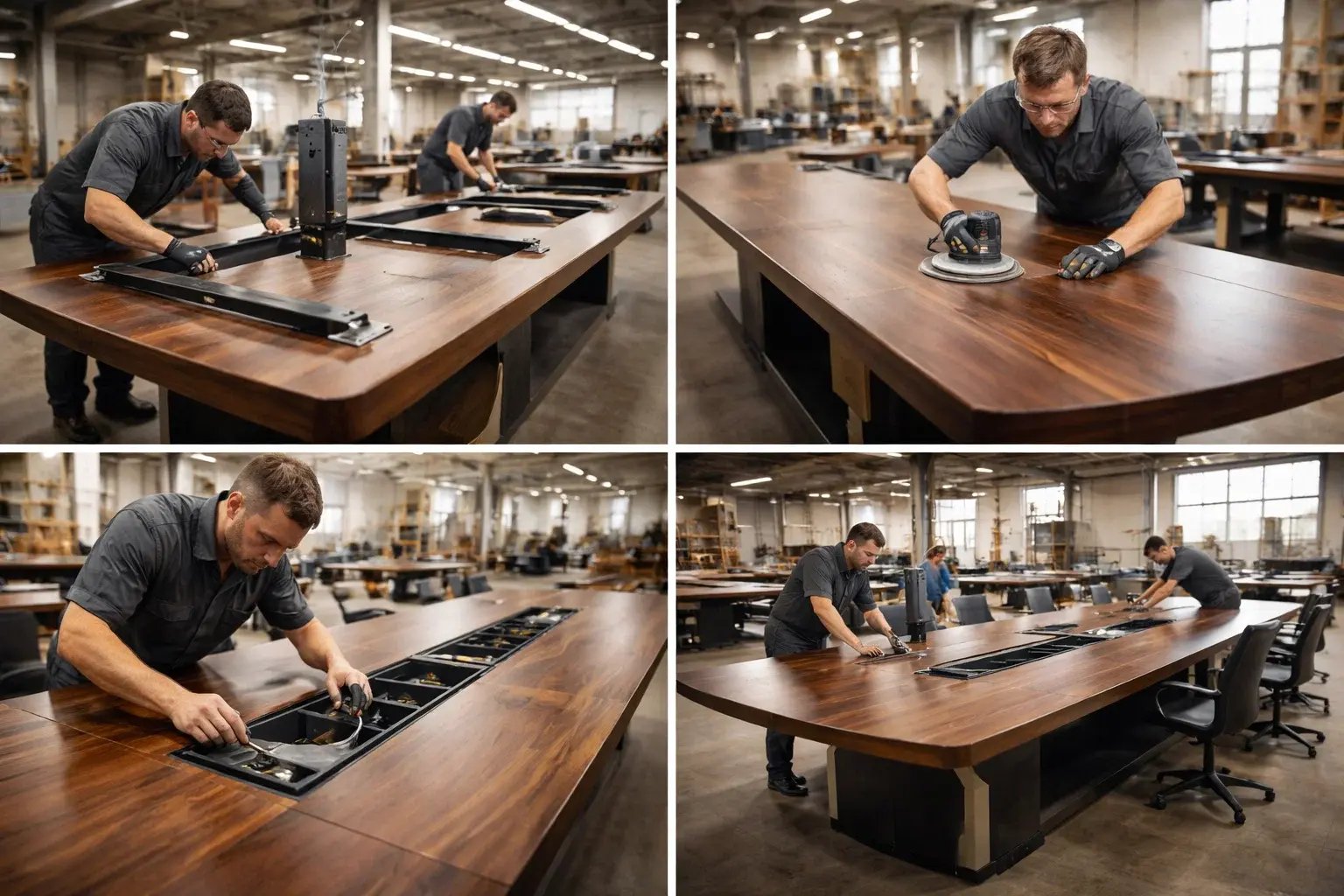
The third variable is base structure and stability. A large conference table — particularly one seating ten or more people — needs a base structure engineered for the load and use pattern it will experience. Bases that look substantial in a photograph can flex, creak, or show surface wear at stress points within an accelerated timeframe if the engineering does not match the visual impression. Buyers who evaluate base specifications in detail, not just aesthetics, consistently make better long-term purchases.
The fourth variable is integration with the surrounding environment. A conference table does not exist in isolation. It needs to visually and functionally integrate with the room's seating, lighting, acoustic treatment, presentation wall, and storage. Buyers who source the table in isolation and then try to integrate it with separately sourced elements frequently end up with environments that lack coherence — not because individual pieces are poor quality, but because they were not designed to work together.
Why Wholesale Manufacturers Offer Structural Advantages for Corporate Sourcing
The wholesale manufacturer model — where the entity producing the furniture sells directly to corporate buyers, project contractors, and dealers without a retail intermediary — offers structural advantages that are directly relevant to corporate procurement.
The most significant is customisation without premium pricing. Retail and showroom-based suppliers work from fixed product ranges. Customisation — whether dimensional, material, or configuration — is priced as an exception from a standard. For wholesale manufacturers, customisation is the standard operating model. They are set up to produce to specification rather than from a catalog. For corporate buyers with specific dimensional or material requirements, this means the cost of getting exactly what you need is built into the base price rather than added as a premium.
The second advantage is direct quality accountability. When you purchase from a wholesale manufacturer, the entity you are dealing with is the entity that made the product. Quality questions, specification queries, and post-delivery issues are resolved at source rather than filtered through a retail or distribution intermediary. This direct accountability structure produces faster, cleaner resolution of the issues that arise in any commercial furniture purchase.
The third advantage is volume pricing that reflects manufacturing economics rather than retail margins. For corporate buyers sourcing conference furniture for multiple rooms, floors, or sites, the volume pricing available from wholesale manufacturers — particularly those in regional clusters — produces landed costs that retail sourcing cannot approach at comparable quality.
How to Evaluate a Conference Table Wholesale Supplier
Corporate procurement teams approaching wholesale manufacturers for the first time benefit from a structured evaluation process. The following criteria consistently separate reliable wholesale suppliers from those who cannot deliver at corporate specification standards.
Material and Construction Specification
Request a written specification for every product configuration you are considering. This document should state the substrate material and density, the surface laminate grade and thickness, the edge treatment specification, the base material and finish, and the hardware specifications for any integrated features such as cable management ports, power modules, or folding mechanisms.
Suppliers who provide this documentation without being asked are demonstrating the product transparency that characterises manufacturers confident in their quality. Suppliers who provide general descriptions rather than specifications are signalling either inconsistency or an unwillingness to be held accountable to a defined standard.
Sample and Reference Verification
For a purchase of this visibility and cost significance, reviewing a physical sample is not optional. Request a sample of the proposed surface finish and edge treatment in the actual materials to be used — not a showroom display piece. Assess the finish quality under different lighting conditions, apply pressure to test flex and stability, and examine the edge treatment at close range.
Reference verification should include at least one visit to a completed corporate installation where you can see the product in actual use at a comparable age. A table that has been in daily corporate use for eighteen months tells you far more about its durability than any sample or showroom piece.
Lead Time and Delivery Capability
Confirm the manufacturer's current production schedule and realistic lead time for your specific configuration before you commit. For corporate fit-out projects tied to lease commencements or facility openings, delivery timeline reliability is a critical procurement criterion, not a secondary consideration.
Ask specifically about the delivery and installation process. How is the table transported to protect surface finish during transit? Is installation performed by the manufacturer's team or subcontracted? What is the process for assessing and remediating any transit damage discovered at installation?
Warranty and Post-Delivery Support
A minimum three-year warranty on structural integrity and surface finish is a reasonable corporate expectation. Confirm what the warranty covers, what it excludes, and what the response protocol is for warranty claims. A warranty that exists in a document but has no practical claims process is not a warranty — it is a sales tool.
The Design Dimension of Corporate Conference Environments
One aspect of conference table procurement that corporate buyers increasingly recognise as consequential is the design integration dimension. A conference room is not just a functional space. It is a representation of the organisation's identity, culture, and operational seriousness.
The commercial interior designers Tamil Nadu cluster has produced in recent years — particularly in Coimbatore — brings a design capability to conference environment specification that extends well beyond selecting a table shape and surface finish. Experienced suppliers in this cluster can engage with questions of room proportion, acoustic performance, lighting integration, technology accommodation, and visual coherence in ways that produce conference environments that function as well as they present.
For corporate buyers who are specifying a boardroom, a client-facing meeting suite, or a flagship conference facility, engaging a supplier with this design depth produces a qualitatively different outcome from sourcing a table in isolation. The additional investment in design engagement is typically marginal relative to the total project cost and significant relative to the long-term value of the space.
Common Mistakes Corporate Buyers Make With Conference Furniture
Four procurement errors appear consistently enough in corporate conference furniture sourcing to warrant direct attention.
The first is specifying seating capacity without specifying use patterns. A table that seats twelve for a formal meeting seats eight comfortably for a working session with laptops, documents, and power requirements. Specify what the room needs to support in its most demanding use configuration, not its most formal one.
The second is neglecting cable and power management at the specification stage. Integrated cable management and power modules are significantly more cost-effective when specified and built into the table at manufacturing than when retrofitted after installation. This is a detail that experienced buyers include in their initial specification and inexperienced buyers discover they need after the table is installed.
The third is treating the table purchase as independent of the seating purchase. Conference chair height, arm configuration, and caster type all affect how a conference table functions in use. Buyers who source these elements separately — without coordinating dimensional specifications — frequently encounter ergonomic mismatches that affect the usability of the room for its entire service life.
The fourth is accepting a standard finish because customisation seems complicated. Wholesale manufacturers in established clusters are set up for specification-based production. Requesting a specific surface finish, a non-standard dimension, or a particular edge profile is routine for them. Buyers who default to standard catalog options because they assume customisation is expensive or slow often discover — too late — that the standard option does not optimally serve their space.
 Conclusion
Corporate conference furniture is a purchase that represents your organisation every day — to clients, to leadership, and to the people who work in the space. The procurement decision that determines its quality deserves the same structured discipline that significant capital purchases receive.
Wholesale manufacturers in Coimbatore's commercial furniture cluster offer corporate buyers a combination of customisation capability, material quality, direct accountability, and competitive pricing that positions them as a genuinely credible sourcing option for organisations that want to get this purchase right.
The evaluation framework — specification transparency, sample verification, reference visits, lead time confirmation, and warranty clarity — is straightforward to apply and consistently produces better procurement outcomes than catalog-based sourcing from retail intermediaries.
For corporate procurement teams ready to approach this category with the rigour it deserves, partnering with established modular office furniture Coimbatore manufacturers and wholesalers who can deliver across the full commercial interior scope — from conference environments to complete workplace systems — is a sourcing decision that serves the organisation well beyond the initial project.
The conference room is where your organisation presents itself. Source it accordingly.
FAQs
Q1: What dimensions should a corporate buyer specify for a conference table intended to seat twelve people?
A twelve-seat conference table typically requires a minimum length of 3.6 metres and a width of 1.2 metres to seat participants comfortably with adequate working space. These dimensions should be validated against the specific room dimensions and door clearances before finalising. For rooms where the table will be used with laptops and documents simultaneously, consider a width of 1.35 to 1.5 metres. Always specify with the room's circulation requirements in mind — a minimum of 1 metre clearance between the table edge and the wall or any fixed furniture is the standard reference point.
Q2: How should a corporate buyer assess the structural quality of a conference table base before purchasing?
Ask the supplier to provide the base material specification — steel gauge for metal bases, timber species and joinery method for wooden bases — and the load rating for the base configuration you are considering. If possible, physically test a sample or display piece by applying lateral pressure at the table edge and assessing flex. Ask specifically whether the base is welded or bolted at key joints, as welded steel bases consistently outperform bolted equivalents for long-term structural stability under daily commercial use.
Q3: Is it practical to source conference tables and workstation furniture from the same wholesale manufacturer?
Yes, and it is generally advisable for projects where visual coherence across the environment matters. Sourcing both categories from the same manufacturer ensures surface finish consistency, dimensional coordination, and a single accountability point for the complete installation. For corporate buyers fitting out a full floor or facility, this consolidated sourcing approach also simplifies procurement administration and creates leverage for volume pricing across the complete scope.
Q4: What lead time should a corporate buyer plan for when sourcing a custom-specified conference table from a wholesale manufacturer?
For custom-specified conference tables — non-standard dimensions, specific surface finishes, or integrated power and cable management features — a lead time of four to six weeks from order confirmation is a reasonable planning assumption for established wholesale manufacturers operating at normal capacity. For projects with fixed installation deadlines, confirm the lead time in writing at the quotation stage and include a delivery milestone in your purchase order with a clear protocol for managing delays.